Disaster Medicine Physicians and Surgeons: RSU residents learn tactical pre-hospital care for combat casualties in pilot project


Autors: RSU Medicīnas izglītības tehnoloģiju centrs
Cabinet Regulation No. 630, ‘Regulations on the Register of Medical Practitioners and Medical Support Personnel’ (1 October 2024), defines the following therapeutic and diagnostic methods in medical practice: Disaster Medicine Physician (M77) and Disaster Medicine Surgeon (M78).
The description of these methods provides that a disaster medicine physician is any doctor who has acquired the disaster medicine physician method and is able to independently provide qualified internal medical care to patients injured during a military conflict or as a result of a disaster. A disaster medicine surgeon is a doctor of any surgical specialty who has acquired the disaster medicine surgeon method and is able to independently provide qualified surgical care to patients injured during a military conflict or as a result of a disaster. At the same time, it is stipulated that these methods are to be applied in accordance with the regulations of the National Armed Forces or, in emergency situations, in accordance with the National Disaster Medicine Plan.
To ensure the acquisition of these methods, the Rīga Stradiņš University (RSU) Department of Residency has implemented a pilot project aimed at introducing structured training based on international standards in order to strengthen the professional preparedness of residents.
This pilot project is a strategically important step in strengthening the professional preparedness of residents. The aim of the project is to provide a structured training based on international standards that prepares doctors to respond in difficult, non-standard and high-risk situations.
Prof. Ilze Grope, Dean of the Department of Residency

First practical stage: TCCC tier 4 course
The implementation of the pilot project was the first step towards launching the Disaster Medicine Physician and Disaster Medicine Surgeon training programmes. As part of this pilot project, in February 2026, the Medical Education Technology Centre (RSU METC) hosted the first 68-hour professional development course entitled Tactical Care of Battle Victims Ahead of Hospital Stage, Tier 4. The programme is based on the international Tactical Combat Casualty Care (TCCC) standards developed by the National Association of Emergency Medical Technicians (NAEMT) in the United States. The programme was completed by 19 RSU residents from various specialties: anaesthesiology and resuscitation, emergency medicine, traumatology and orthopaedics, medical genetics, family medicine, gynaecology and obstetrics, sexology and sexopathology, and pulmonology.
Raimonds Mihaļovs, a simulation instructor in the field of tactical military medicine at the NAEMT TCCC course Affiliate Faculty in Latvia and at the RSU METC, notes: ‘Tier 4 of the TCCC programme is specifically designed for medical personnel. The programme’s unique approach is based on a concept that fosters critical thinking in response to surrounding conditions and develops the knowledge and skills required to provide care to casualties in various threat zones – Care Under Fire, Tactical Field Care, Prolonged Field Care, and Tactical Evacuation Care – in military tactical conditions. At the same time, a key component of the programme is the development of structured thinking and triage skills, which are particularly important in situations of limited resources and increased risk.’
Structured and simulation-based learning approach
The programme’s organisational structure included theoretical instruction in the form of self-directed learning, reinforcement of theoretical knowledge through in-person classes, practical skills stations, simulation scenarios in an immersive environment, and finally a mass-casualty exercise (MASCAL) conducted in a safe and controlled environment closely resembling reality. The programme was implemented by lecturers of the Department of Anaesthesiology, Intensive Care and Clinical Simulations – Darja Smirnova, Paula Zviedre, and Anastasija Dergunova-Zimina – under the leadership of Prof. Oļegs Sabeļņikovs, and METC simulation instructors in tactical military medicine – Larisa Ramoniene, Jānis Ramonas, Sabīne Jablonska, and Kristiāns Hščanovičs.
Such an approach ensures the strengthening of integrated knowledge and skills, develops situational thinking and teamwork, as well as facilitates professional preparedness to respond in real crisis situations and environments of increased threat, including circumstances where resources are limited.
Assoc. Prof. Oļegs Sabeļņikovs, Head of the Department of Anaesthesiology, Intensive Care and Clinical Simulations

In the theoretical part of the course, residents gained an in-depth understanding of the conceptual basis of the MARCH-PAWS algorithm and its systematic application in accordance with TCCC principles. The algorithm provides for the sequential identification of life-threatening conditions and immediate intervention within the framework of tactical medicine. The training content included control of massive haemorrhage, airway management, and the diagnosis and treatment of respiratory compromise, including chest trauma, as well as the maintenance of hemodynamic stability and the prevention of hypothermia. Additional stabilisation measures were also covered, including adequate analgesia, early antimicrobial therapy, wound care, and immobilisation of skeletal injuries.
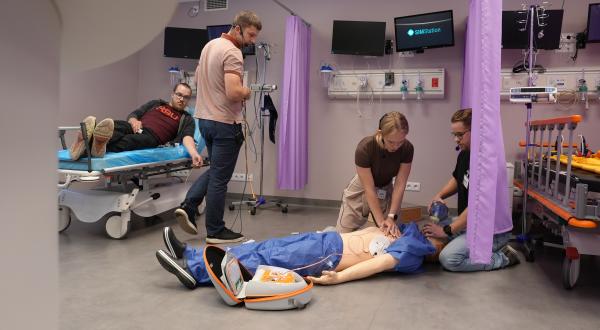
The theoretical classes were followed by skills workshops, where residents practiced tactical procedures under instructor supervision, improving technical precision and strengthening the procedural (tactile) memory using specialised training mannequins and simulation equipment. The practical skills training continued through the implementation of several clinical simulation scenarios in an immersive environment designed to mimic military conditions.
MASCAL simulation – realistic crisis environment
At the conclusion of the programme, on 24 February, a mass-casualty exercise (MASCAL) was conducted at the RSU Medical Education Technology Centre. The scenario was based on experiences from modern armed conflicts, including the war in Ukraine, where injuries caused by explosions and shrapnel are prevalent, as well as injuries caused by unmanned aerial vehicles in civilian areas. To ensure that the training environment reflected the conditions of a real-life crisis situation as accurately as possible, the METC lobby was filled with smoke using smoke generators and smoke candles, significantly reducing visibility. At the same time, an alarm siren was sounded, creating additional psychological stress and hindering communication, thereby simulating a high-risk environment. During the simulation, residents had to demonstrate teamwork skills, perform triage of casualties, determine treatment priorities, plan and organise the distribution of limited resources, and assess the tactical situation. As part of the scenario, six simulated casualties were treated, their roles played by specially trained simulation participants, thereby creating an environment that was as realistic and emotionally intense as possible. High-fidelity mannequins, specific to military medicine, were additionally used to simulate severe injuries.
‘It was a valuable experience. Everything was organised at the highest level, and I did not feel that it was just a training simulation. The main conclusion for me and the other participants is that we would very much not want to find ourselves in a situation where this becomes reality,’ says Klāvs Putenis, a first-year resident in Traumatology and Orthopaedics.
A look into the future
The course developers and instructors emphasise that the aim is not to “prepare residents for war”. The objective is broader: to build doctors’ professional resilience, leadership, and ability to respond in situations marked by uncertainty, time pressure, and limited resources. It is a conscious investment in doctors’ clinical thinking, teamwork, and decision-making in situations where a person’s life may depend on them.
‘No one can be fully prepared for war; however, training allows the acquisition of a structured model of action when dealing with military-type injuries, thereby reducing the potential loss of life. This structured model is not simply an algorithm – it is a culture of thinking that helps to maintain focus in times of crisis, establish priorities, and act purposefully,’ emphasises instructor Larisa Ramoniene.
Rīga Stradiņš University understands its role in strengthening national security and public health. Therefore, in the near future Modules 2 and 3 of the Disaster Medicine Physician and Disaster Medicine Surgeon training programmes will also be implemented to ensure comprehensive mastery of these methods. This represents an investment in the future – doctors who are able to act decisively and maintain professional clarity even in the most critical moments.
We express our sincere gratitude to the role players – Monta Apine, Ārija Baltiņa, Jolanta Gērmane, Emīlija Oša, Jānis Laizāns, and Tenis Nigulis – whose involvement and professional performance were essential in ensuring that the training simulation was conducted successfully and as realistically as possible.